


The U.S. economy continues to expand, but hotel investors are facing a very different story. Revenue per available room (RevPAR) and average daily rate (ADR) growth remain stubbornly low despite stable GDP gains. That divergence has many asking: Is the hotel industry entering its own recession?
Recent data from STR and CoStar reveal just how sharp the slowdown has become. Year-to-date RevPAR growth is up only 0.2%, while ADR has increased just 1%, both well below inflation. This means hotels are actually earning less in real terms—a concerning signal for a sector that once led post-pandemic recovery. The disconnect between macroeconomic resilience and micro-level stagnation suggests a deeper, sector-specific slowdown may be unfolding.
The Select-Service Struggle: A Shift in Investor Sentiment
The select-service hotel segment—once the industry’s darling—is now under intense pressure. Baird recently downgraded RLJ Lodging Trust to Neutral and added a bearish pick on Summit Hotel Properties (INN) after several months of disappointing RevPAR trends.
According to the report, September RevPAR came in 100–200 basis points below expectations, marking the fourth straight month of negative growth. Leisure demand has softened across nearly all markets, and guests are increasingly opting for discounted or prepaid rates instead of standard bookings.
Even traditional corporate and government segments—normally stabilizers for this tier—are faltering. Analysts see unfavorable cycle dynamics and weak near-term visibility, predicting continued earnings pressure through at least early 2026.
The takeaway: select-service REITs are in a reset period, facing slower growth, tighter margins, and limited pricing power.
Clarion–Noble Courtyard Transaction: A Contrarian Bet
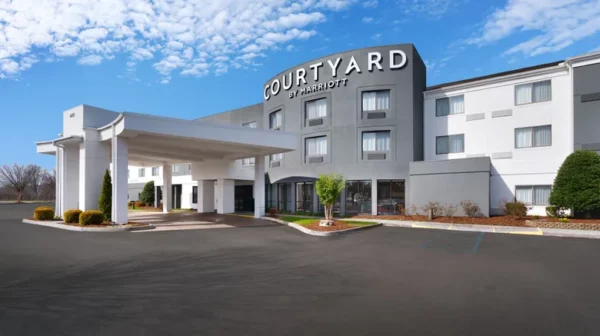
Against that backdrop, Noble Investment Group’s acquisition of 51 Courtyard by Marriott hotels from Clarion Partners stands out as a rare show of confidence. The portfolio spans 7,528 rooms across 25 U.S. states—a true nationwide footprint in the hotel for sale space.
Though pricing wasn’t disclosed, estimates based on comparable data suggest Noble’s all-in cost could range between $750 million and $1 billion, depending on capital expenditure assumptions. A capex-per-room analysis implies that even at a moderate $100,000–$120,000 purchase price per key, the deal would land well below replacement cost.
Clarion had already invested $250 million in renovations between 2019 and 2024, roughly $5 million per hotel. That recent refresh lowers Noble’s immediate renovation burden, allowing the group to focus on operational optimization rather than heavy construction.
This looks like a textbook counter-cyclical acquisition: buying stable, branded assets in a downturn, backed by a large domestic pension fund partner. It’s a signal that institutional investors still see hotels for sale as long-term winners—just not at yesterday’s prices.
Private Capital Steps In as REITs Pull Back
While public REITs are grappling with compressed share prices, private capital continues to quietly accumulate real estate. Realty Income’s (“O”) launch of its $716 million Core Plus Fund exemplifies this shift. The fund—seeded with 183 income-generating properties—marks O’s move deeper into private commercial real estate, a space roughly 10 times the size of the public REIT market.
As O’s CEO noted, the $2 trillion REIT sector is dwarfed by the $20 trillion private CRE market. That means the most active hotel transactions today are happening off the public radar, where patient capital is targeting durable cash flows rather than quarterly performance.
This divergence reinforces a key theme of the slowdown: the public market is retreating from risk, while private capital is stepping in to capture discounted long-term opportunities.
A Sector in Secular Recession: The Data Behind the Narrative
STR and CoStar’s analysts have called this trend what it likely is—a secular slowdown. Despite solid macroeconomic indicators, hotel metrics remain muted.
Several structural factors are driving the stagnation:
- Post-COVID travel shifts: Americans are increasingly traveling abroad, while inbound international tourism remains weak.
- Localized oversupply: Markets like Nashville and Phoenix continue to face an excess of new rooms that outpace demand.
- Labor pressure: Hospitality job growth is stalling, with ADP data showing 19,000 job losses in leisure and hospitality in September 2025, the second consecutive month of declines.
These signals align with what many operators are reporting—shrinking margins, softer demand, and lower pricing power even in peak months. While lower interest rates could offer relief, the fundamentals suggest that this slowdown is structural, not cyclical.
Westin Westminster: Finding Opportunity in Dislocation
One recent transaction demonstrates that opportunities still exist for disciplined investors. Columbia Sussex’s acquisition of the 370-room Westin Westminster between Denver and Boulder for $113 million ($305K per key) reflects a selective, yield-driven approach to hospitality investing.

The deal includes an $8.5 million property improvement plan ($23K per key) and was financed through a $78 million CMBS loan at a 6.51% fixed rate—a structure yielding a 12% levered cash-on-cash return.
Despite broader weakness in RevPAR growth, this acquisition illustrates how private buyers are using smart leverage, moderate capex, and stable debt terms to generate attractive risk-adjusted returns. In short, while REITs are constrained by quarterly optics, private firms like Columbia Sussex can play the long game.
Reset, Not Retreat
The hospitality sector is undeniably in a slowdown—perhaps even a sector-specific recession—but the story is more nuanced than pure decline. Public hotel REITs like RLJ are absorbing the brunt of earnings pressure, while private capital is quietly setting the stage for the next growth phase.
Noble’s Courtyard acquisition and Columbia Sussex’s Westin deal demonstrate that institutional investors are still confident in long-term fundamentals, provided the price and capex assumptions make sense. The capital hasn’t disappeared; it’s simply become more selective.
This cycle is less about survival and more about recalibration. Operators who control costs, preserve liquidity, and position for recovery are likely to emerge strongest when RevPAR growth stabilizes—potentially by 2026.
If you’re an investor, operator, or capital allocator seeking clarity on this evolving hotel cycle, contact us today.